Physical Address
304 North Cardinal St.
Dorchester Center, MA 02124
Physical Address
304 North Cardinal St.
Dorchester Center, MA 02124

Recruitment across Africa is undergoing a significant transformation. As businesses embrace digital technologies and the workforce becomes increasingly diverse, traditional hiring methods are being replaced by smarter, more efficient approaches. Employers are no longer relying solely on manual CV screening or keyword searches to identify suitable candidates. Instead, many organizations are turning to artificial intelligence (AI) to streamline recruitment and make more informed hiring decisions.
AI-powered job matching uses intelligent algorithms to connect candidates with opportunities that align with their skills, experience, qualifications, and career aspirations. Rather than focusing only on job titles or specific keywords, these systems analyze multiple factors to recommend better matches for both employers and job seekers. This helps reduce hiring time, improve recruitment accuracy, and create a more personalized experience throughout the hiring process.
Across Africa, where digital adoption continues to accelerate and businesses are expanding across borders, AI-powered recruitment is becoming an important tool for addressing talent shortages and improving workforce mobility. Whether someone is searching for Jobs in Ghana, exploring Jobs in Nigeria, or hiring professionals across multiple African markets, intelligent job matching is helping connect the right people with the right opportunities more efficiently than ever before.
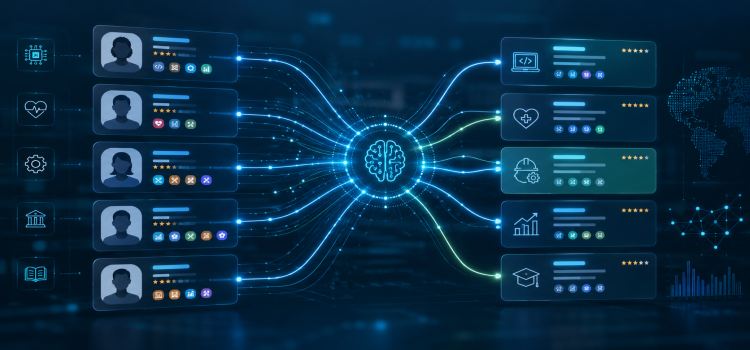
Artificial intelligence has introduced a new way of thinking about recruitment. Rather than treating hiring as a manual process that depends heavily on recruiters reviewing hundreds of applications, AI-powered job matching uses data and machine learning to identify candidates who are most likely to succeed in a particular role.
Unlike traditional recruitment systems that rely primarily on exact keyword matches, AI evaluates a broader range of information. It considers factors such as technical skills, work experience, education, certifications, career progression, industry background, preferred work arrangements, and even transferable skills that may not be immediately obvious.
For example, a candidate with experience in data analytics within the banking sector may also possess valuable skills for opportunities in healthcare, telecommunications, or logistics. Traditional recruitment systems might overlook these connections, while AI-powered matching can recognize similarities between roles and recommend relevant opportunities.
This intelligent approach benefits both employers and candidates. Businesses spend less time reviewing unsuitable applications, while job seekers receive recommendations that better reflect their capabilities and long-term career goals. The result is a recruitment process that focuses on quality rather than simply processing large volumes of applications.
As organizations continue to adopt digital recruitment technologies, AI-powered matching is becoming an increasingly valuable tool for creating stronger connections between talent and opportunity across Africa.
Recruitment has traditionally been a time-consuming process. Employers often receive hundreds or even thousands of applications for a single vacancy, requiring recruiters to manually review CVs, compare qualifications, schedule interviews, and communicate with candidates throughout the hiring process. While this approach has worked for many years, it has become increasingly difficult to manage as organizations expand and the volume of applications continues to grow.
Manual recruitment also presents several challenges. Recruiters may unintentionally overlook qualified candidates because of inconsistent CV formats, missing keywords, or the sheer number of applications they need to review within a limited timeframe. At the same time, job seekers frequently submit applications to positions that may not align with their skills or career aspirations, resulting in lower-quality matches for both parties.
Another challenge is the increasing demand for specialized skills. Industries such as technology, engineering, healthcare, and financial services require professionals with highly specific competencies. Identifying candidates who possess the right combination of technical expertise and workplace skills through manual screening alone can be both time-consuming and resource-intensive.
Businesses are also under pressure to reduce their time-to-hire. Delays in filling critical positions can affect productivity, customer service, and business growth. AI-powered recruitment addresses these challenges by automating repetitive tasks, improving candidate matching, and allowing recruiters to focus on building relationships with qualified applicants rather than sorting through large volumes of unsuitable applications.
As hiring needs become more complex, organizations across Africa are increasingly adopting technology that enables faster, more accurate, and more scalable recruitment processes.

For employers, AI-powered recruitment offers far more than automation. It provides valuable insights that help organizations make better hiring decisions while improving efficiency throughout the recruitment process.
Some of the key benefits include:
These advantages are particularly valuable for organizations hiring at scale or recruiting across multiple locations. Instead of manually comparing hundreds of applications, recruiters can focus their attention on engaging with candidates who are already well aligned with the role.
AI also supports skills-based hiring by identifying transferable capabilities that may not be immediately visible through traditional screening methods. This enables employers to discover promising candidates who might otherwise have been overlooked, helping businesses build stronger and more diverse teams.
Importantly, AI does not replace human decision-making. Instead, it enhances the recruitment process by providing recruiters with better information, allowing them to spend more time evaluating qualities such as communication, cultural fit, leadership potential, and long-term career aspirations.
Artificial intelligence is not only changing the way organizations recruit talent; it is also improving the experience for job seekers. Instead of searching through hundreds of vacancies that may only partially match their qualifications, candidates can receive personalized recommendations based on their unique skills, experience, and career preferences.
Modern AI-powered recruitment platforms analyze multiple aspects of a candidate’s profile rather than relying exclusively on job titles. This allows professionals to discover opportunities they may not have considered, including roles where their transferable skills are highly relevant.
For example, someone with experience in project coordination may be matched with positions in operations, technology implementation, consulting, or product management based on the competencies they have developed throughout their career. This broader perspective creates new opportunities while reducing the frustration often associated with traditional job searching.
AI can also help candidates identify gaps in their profiles by recommending additional skills, certifications, or experiences that may improve their employability. This enables professionals to make informed decisions about their career development and remain competitive in an evolving job market. The International Labour Organization also emphasizes that lifelong learning and continuous skills development are becoming increasingly important as technology transforms labor markets and creates new employment opportunities.
As discussed in Beyond Qualifications: What African Employers Really Want, organizations increasingly evaluate candidates based on a combination of technical expertise, practical experience, adaptability, and workplace skills. AI-powered job matching supports this shift by considering a wider range of attributes when recommending opportunities, helping candidates find roles that align not only with their qualifications but also with their overall potential.
Artificial intelligence is reshaping recruitment across a wide range of industries, helping organizations identify qualified candidates more efficiently while improving the overall hiring experience. As digital transformation continues across Africa, businesses are increasingly adopting AI-powered recruitment solutions to address talent shortages, improve workforce planning, and make more informed hiring decisions.
The technology sector has been one of the earliest adopters of AI-driven recruitment. With growing demand for software developers, cybersecurity specialists, cloud engineers, and data analysts, companies are using intelligent matching systems to quickly identify candidates with specialized technical expertise. This is particularly valuable for organizations hiring for IT Jobs in Nigeria, where competition for skilled technology professionals continues to increase.
Healthcare organizations are also embracing AI to recruit medical professionals, administrative staff, and healthcare specialists more efficiently. Similarly, financial institutions are using recruitment technology to source professionals with expertise in digital banking, financial analysis, compliance, and cybersecurity.
Other industries experiencing significant benefits include engineering, logistics, manufacturing, education, retail, and telecommunications. As organizations continue to invest in digital transformation, AI-powered recruitment is becoming an essential tool for attracting professionals with both technical and transferable skills.
Regardless of the industry, the goal remains the same: connecting qualified candidates with opportunities where they are most likely to succeed while enabling employers to make faster and more confident hiring decisions.
While AI has introduced significant improvements to recruitment, it is not without challenges. Organizations implementing AI-powered hiring solutions must ensure that technology supports fair, transparent, and ethical recruitment practices rather than replacing thoughtful human decision-making.
One important consideration is data quality. AI systems rely on the information provided through candidate profiles, job descriptions, and historical recruitment data. Incomplete or inaccurate information can affect matching accuracy and reduce the effectiveness of automated recommendations.
Transparency is another important factor. Both employers and job seekers benefit from understanding how AI contributes to recruitment decisions. Organizations should ensure that technology supports informed decision-making rather than functioning as an unexplained “black box.”
Data privacy also remains a key priority. Recruitment platforms handle large volumes of personal information, making it essential to protect candidate data through secure systems and responsible data management practices. Employers should also ensure that their recruitment processes comply with relevant privacy regulations and maintain candidate trust throughout the hiring journey.
Finally, organizations should recognize that AI is designed to support recruiters, not replace them. Human judgment remains essential when assessing communication skills, leadership potential, motivation, and organizational fit. The most effective recruitment strategies combine intelligent technology with experienced hiring professionals who understand both business needs and human potential.

Africa’s workforce is becoming increasingly connected, digitally skilled, and geographically mobile. As organizations expand across borders and industries continue to embrace digital transformation, recruitment is expected to become more intelligent, data-driven, and personalized.
Future AI-powered recruitment platforms are likely to move beyond matching candidates based solely on qualifications and work experience. Advanced systems will increasingly evaluate skills, learning potential, career aspirations, and transferable competencies, enabling organizations to identify talent with long-term growth potential rather than simply filling immediate vacancies.According to the World Economic Forum’s Future of Jobs Report, advances in artificial intelligence, big data, and digital technologies are reshaping workforce requirements, making skills-first hiring and continuous learning increasingly important for both employers and professionals.
Predictive analytics is also expected to play a larger role in workforce planning. Instead of reacting to hiring needs after vacancies arise, organizations will be able to anticipate future talent requirements, identify emerging skills gaps, and develop proactive recruitment strategies.
Cross-border hiring is another area where AI can create significant value. As businesses expand across African markets, intelligent recruitment platforms can help employers identify qualified professionals from multiple countries while simplifying the hiring process for candidates seeking regional opportunities.
At the same time, AI will continue supporting job seekers by providing more personalized career recommendations, identifying relevant learning opportunities, and helping professionals develop skills that align with future workforce demands. This shift has the potential to improve workforce mobility and strengthen employment opportunities across the continent.
Despite rapid advances in artificial intelligence, recruitment remains fundamentally about people. Technology can process information, identify patterns, and automate repetitive tasks, but it cannot fully understand the human qualities that often determine long-term success within an organization.
Recruiters play an important role in evaluating qualities such as emotional intelligence, leadership potential, communication style, motivation, and cultural fit. These characteristics are often best assessed through conversations, interviews, and professional interactions rather than algorithms alone.
Similarly, candidates benefit from human guidance throughout the recruitment process. Career advice, interview preparation, salary discussions, and feedback require empathy and context that technology cannot always provide.
The most successful recruitment strategies therefore combine the strengths of both technology and human expertise. AI improves efficiency by reducing administrative work and providing data-driven recommendations, while recruiters focus on building relationships, understanding business needs, and making thoughtful hiring decisions.
Rather than replacing recruiters, AI allows them to spend more time doing what matters most: connecting people with meaningful career opportunities and helping organizations build high-performing teams.
Artificial intelligence is redefining recruitment across Africa by making hiring more efficient, accurate, and accessible for both employers and job seekers. From reducing manual screening to providing personalized job recommendations, AI-powered job matching is helping organizations make better hiring decisions while enabling professionals to discover opportunities that align with their skills and career goals.
As digital transformation continues across industries, businesses that embrace intelligent recruitment technologies will be better positioned to attract high-quality talent, reduce hiring costs, and respond more quickly to changing workforce needs. At the same time, job seekers who invest in developing relevant skills and maintaining strong professional profiles will benefit from increasingly personalized career opportunities.
The future of recruitment is unlikely to be driven solely by technology or solely by people. Instead, it will be shaped by the combination of intelligent systems and experienced recruiters working together to create fairer, faster, and more effective hiring experiences.
Whether you are searching for your next opportunity or looking to build a stronger team, understanding how AI-powered job matching works can help you navigate the future of recruitment with greater confidence.
AI-powered job matching is transforming recruitment by helping employers identify qualified candidates more efficiently while providing job seekers with personalized career opportunities.
Key takeaways include: